Thursday, February 25, 2010

Bloomberg Commits to Water Quality Improvements In Jamaica Bay

It's about time.

The city put out a press release today with some vague details on the new Jamaica Bay water quality improvement plan. While this is a step in the right direction I know I personally would have liked to see more details in the plan. However there is a substantial amount of money being moved into Jamaica Bay wetland restoration which as an avid birder always gets a thumbs up.

The release ran with this opening statement:

"Today marks a new beginning for Jamaica Bay - an amazing recreational and economic resource for New Yorkers," said Lawrence Levine, staff attorney for the NRDC.  "The city has committed to address the biggest source of pollution that has plagued Jamaica Bay for decades. We look forward to continuing to work with Mayor Bloomberg and Commissioner Holloway to turn today's historic commitments into reality."

Friday, February 19, 2010

Welcome to the Jungle

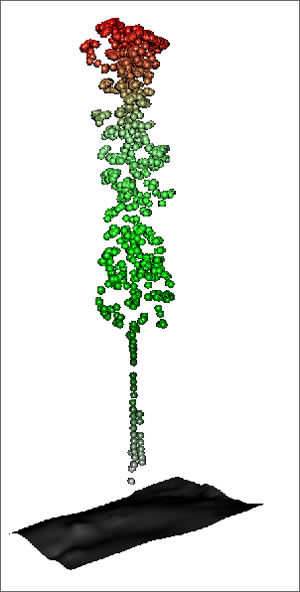
ESRI is a big fan of hammering you with updates about their GIS products as well as updates about the GIS community around the globe. Luckily for me a lot of their publications have environmental undertones which make them less like spam and more like...something useful. In their most recent issue of ArcWatch, I came across a very interesting article about using Lidar technology to map forests; and I don't mean where the forests are, but actually where individual plants are and how big they are.

Lidar stands for Light Detection And Ranging. Without getting into anything too technical, it basically uses pulses of light in the form of lasers to determine the distance to something. This technology has been used a lot to perform remote surveys of large areas to determine elevations and slopes of a landscape. Researchers from Forestry Tasmania have adapted the technology to measure the height of trees and to some degree the amount of foliage that tree has.

Suffice it to say that it is pretty awesome. Especially when you start seeing images of more than 1 plant at a time, you can tell very quickly that this technology will be able to measure a forest's vegetative cover to some extent. Forest managers are already drooling over the prospects.

Check out more details at the ArcWatch article here.
Friday, February 12, 2010

Plastic

The last few days, some of us have been discussing the consequences of plastic bags and waste in general. I'm reading The World Without Us by Alan Weisman right now, and was terrified by his text on the pervasiveness of plastics -- that as plastics break down, they become available for consumption by smaller and smaller organisms, and therefore will eventually find their way through the entire food chain.

The blog at GOOD offers this list of ways to reduce plastic waste: http://www.good.is/post/our-10-favorite-innovations-for-reducing-plastic-consumer-waste/.

I'm most interested by the London store Unpackaged (http://beunpackaged.com), which sells all (most?) products sans packaging -- customers bring their own reusable containers. (Image from GOOD's post on Unpackaged.)

Tuesday, February 2, 2010

Turns Office Paper Into Toilet Paper?!

Came across this cool machine that takes paper in and gives you toilet paper. This is recycling in front of you eyes. I believe that one day( I hope soon) every house will have one of those, like water filter system...
Check out the link... Happy recycling!


Friday, January 22, 2010

Cooperation


Again the idea of co-evolution keeps entering my realm.  This time at my Brooklyn Botanical Garden Botany course Uli, my professor, introduced us to the ant plant.  Myrmecophyte plants, also commonly known as ant plants, native to south Asia are epiphytes.  Epiphytes may often be considered parasitic but they only use their host for physical support.  While the Myrmecophyte plant relies on trees for a home, the plant also is a host for a colony of ants. 


Wednesday, January 20, 2010

Evolutionary Weaponry -- Venom


"If I spit, they will take my spit and frame it as great art." - Picasso

His modesty is commendable, but really humans are millions of years behind other animals in terms of the quality of their spit.

There are many animals in the world today that utilize a variety of venoms to incapacitate prey. Most notable of these are snakes, lizards, spiders, and jellyfish. Few people are aware of the venoms that some mammals have, such as moles and shrews. But if the evolution of venoms occurred in multiple kingdoms at different times, where did they all come from?

Tuesday, January 19, 2010

Living in the Future

In 1972, Geoffrey Hoyle wrote a book called 2010: Living in the Future. It is sometimes spot on -- "vision phones" -- and sometimes not so much -- "in the year 2010 everyone wears a jumpsuit and shoes."


I find it interesting that so many futuristic predictions include uniformity of things like clothing and food production (here, food arrives in tubes and is automatically cooked), yet these particular items have actually trended the other way (at least, that's what I see around me in Brooklyn).

And while simplicity and sustainability are recognized with small, efficient homes and public transportation galore,  electric gadgets are abundant too, and it always seems to be assumed that we will find a way to fuel all of this with clean energy.

Go compare reality with Mr. Hoyle's predictions...

From Boing Boing.